Interview with Alina Șerban by Ismael Cortés
Roma actress and filmmaker Alina Șerban speaks with Ismael Cortés about her journey challenging stereotypes, reclaiming narrative power, and creating space for Roma voices on stage and screen. In this candid interview, she shares her vision of art as a tool for healing, solidarity, and the freedom to simply be human.
In June 2025, the city of Madrid welcomed Alina Șerban—acclaimed Roma actress, director, and playwright—for a transformative workshop. Alina led the initiative as part of the Horizon Europe NARDIV project, in collaboration with the Goethe-Institut.
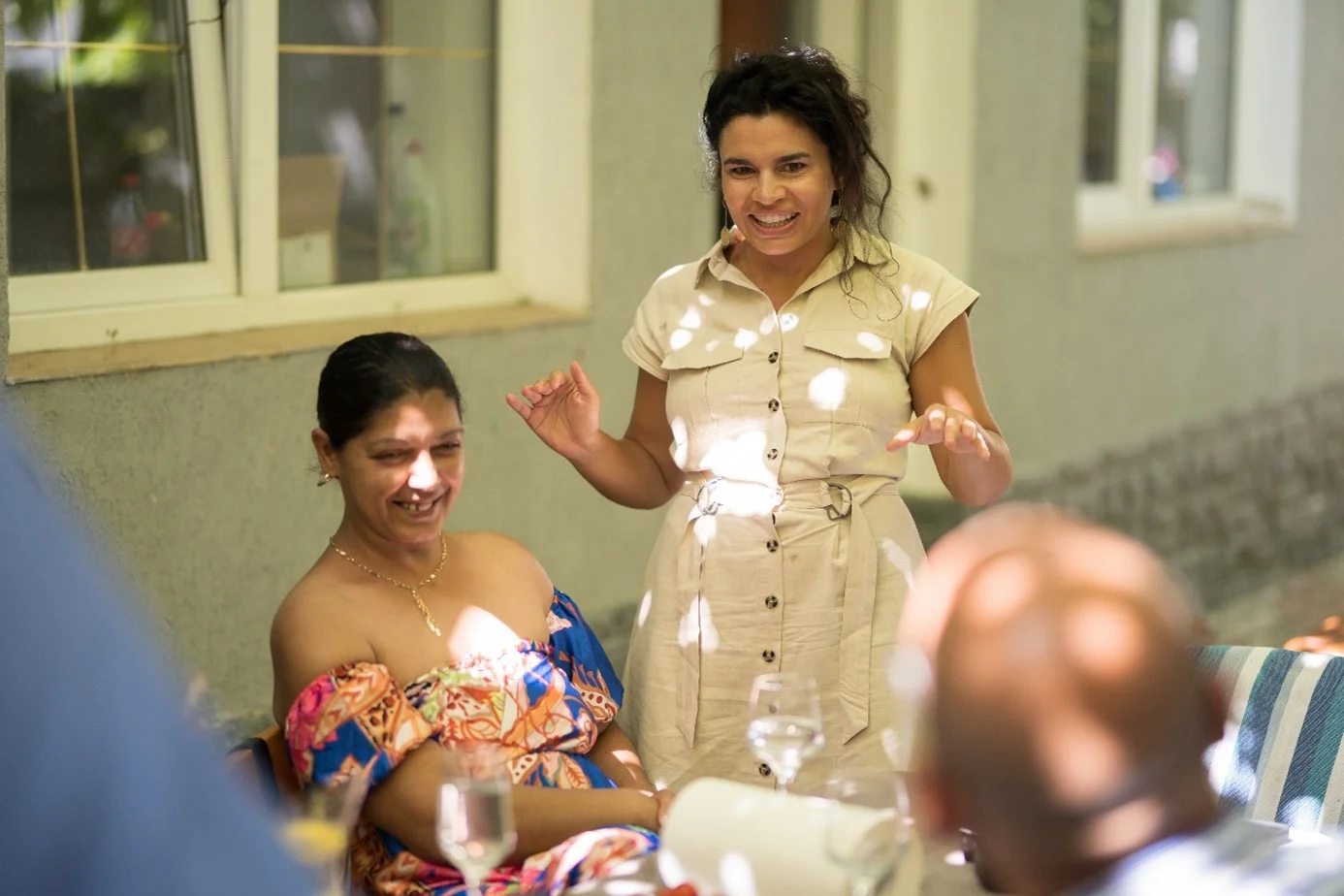
The workshop offered more than just artistic engagement; it created a safe space where participants could speak freely, share lived experiences and reflect on the challenges they face. It was a space for listening, for healing, and above all, for reinforcing confidence and solidarity. Although the core focus of the workshop was on Roma women, the event also opened its doors to men and to non-Roma participants, encouraging meaningful exchange and mutual understanding between communities.
Alina Șerban, recipient of the Romanian Order of Cultural Merit, brought with her not only a rich artistic career but also a deeply rooted commitment to equity, and the power of personal voice.
The workshop opened with a screening of Gipsy Queen, a film directed by Hüseyin Tabak, in which Alina plays the main character. The film has garnered multiple awards, including Best Film at the Biberach Film Festival and the Audience Award at the Tallinn Black Nights Film Festival, and has earned Șerban several Best Actress honours, including in Germany. Powerful and emotionally charged, the film served as a catalyst for reflection, inviting participants to connect through shared experiences of identity, struggle, and inner strength.
How did your experience in Madrid differ, if at all, from similar events elsewhere in Europe?
From the moment I arrived—literally, as I stepped into the taxi—I heard Roma music playing. That’s not something I’m used to, even in my own country. It was a beautiful moment, and it instantly made me feel at home. The presence of Roma culture was palpable from the outset, something I rarely encounter so openly in Romania. You wouldn’t, for example, step into a taxi and hear Roma music in Bucharest.
There’s a paradox here in Spain: Roma culture seems more visible—perhaps due to flamenco—but that visibility doesn’t exempt the community from the systemic racism or cultural appropriation that’s present across Europe: in Romania, Hungary, and elsewhere. Still, to meet Roma people outside my own country, and especially here in Spain, has been deeply joyful and moving for me.
Even though I acknowledge my own limitations in fully understanding Roma culture in Spain, from an outsider’s perspective—and perhaps from my own preconceptions—what stands out is the pride. The Roma people here seem to carry a stronger public pride in their identity. And the music—it’s not just about celebration, but about struggle too. Protest songs, activist songs—songs of la lucha. That has been deeply inspiring. It speaks to a sense of solidarity and connection, even across borders and different lives. A kind of sisterhood and kinship with people I don’t live among, but still feel connected to.
Last night you attended Lisistrata Montoya performed by the Roma Women’s Theatre Company, Gitanas a Escena, directed by Coco Reyes. How did that performance resonate with you—both as an artist and personally?
What struck me most was the sheer necessity for stories—Roma stories, told from Roma perspectives. There is such a profound lack of those voices on stage and screen, and that absence must end.
We need a multitude of Roma narratives: different visions, different interpretations of what it means to be Roma—told from within the community, not imposed from outside. Last night’s performance was a truly honest engagement with identity, history, and the present. I loved seeing Roma women taking the stage, becoming storytellers in their own way. It was not only inspiring—it was healing. And it reinforced, once again, the urgent need to multiply this kind of work, these platforms, these expressions.
You are an artist moving across many geographical, cultural and institutional spaces. How do you maintain your sense of self in the face of expectations others place on you?
It’s extremely difficult. I’m still learning. There are days when I’m full of doubt, and others when I feel I have something close to an answer—only to fall back into doubt again. I think this uncertainty is part of the creative process, and perhaps even part of being human.
It’s about questioning yourself, striving to improve daily, and accepting that beauty might lie in the vulnerability of not knowing. In the failing, and in the trying again. Right now, I’m working on my first feature film. Sometimes the weight of being one of the very few Roma women in the world making a fiction film is overwhelming. But alongside the pressure, there’s also profound joy. I’m just doing my best to keep all of this in balance. Some days I manage. Others, I don’t.
Public perception is often shaped by lazy labels and old stereotypes. What power do artists hold to challenge those assumptions—and invite audiences to see differently?
The answer lies in the act of disruption itself. That refusal to conform. The power to redefine who we are—on our own terms. To contradict ourselves. To change over time.
In these sixteen years, I’ve evolved. I began with fury—fury I still carry—but my perspective has been shaped by experiences along the way. And yes, I’ve changed. That’s allowed.
At the heart of it is the freedom to simply be human. To explore, to grow, to fail. That’s what disrupts the labels: the insistence on complexity, on not giving up, on failing and trying again. That’s the artist’s power.
How do you remain faithful to your own story without being boxed into a single label?
That’s something I’m still grappling with. There are days when I betray my own voice—because I want to be seen as a ‘proper’ artist, to write a script and direct the way it’s supposed to be done. But then I find I am wrestling with myself. Is this good? Is it bad? Who am I trying to please?
What helps me, in the end, is the understanding that what I create will never be perfect—but it can still be true. It can reflect the person I am today. I aim to put something into the world that I would’ve needed myself, growing up. Something I would’ve loved to see.
So I try to listen to my intuition. And when I can hear it clearly, it speaks from a place of personal truth. That truth may not fit the conventions of storytelling perfection—but it is mine.
In the workshop you have spoken of prejudices both within and outside the Roma community. How can theatre and film create space for more honest human depictions?
Theatre and film are incredibly powerful tools for change—especially at scale. One of my greatest dreams is to see such stories reach the masses via free public television. Imagine the power of replacing stereotypes with truth and nuance.
We need to flood the public sphere with alternative narratives—multiple visions of Roma lives. Not one image, not one identity, but many. When that happens, Roma people stop being just one symbol or one label—and start being seen as fully human. People that others can empathise with.

How close are we to that vision becoming a reality?
We’re not there yet. I can say that honestly. I’m struggling. There’s a lack of systemic support. So I do what I can, alone. For instance, I’ve spent my own resources to acquire the rights to Gipsy Queen, just so I could distribute it in Romania. I did it because I know how rare films like this are. We need change—and this is the tool I have. The challenge is distribution. Reaching people. That’s where it gets hard.
Do you see any signs of progress in the industry?
Some. In Romania at least, I’ve noticed small shifts. There are private companies willing to have uncomfortable conversations. They invite me to speak, and allow me to be myself. But that’s the private sector. In terms of institutional support—the systemic kind—we’re still a long way off. I can’t wait for the system to catch up. So I keep pushing forward, inviting allies along the way, trying to reach as many people as I can through my work.
But in today’s world, private media companies wield enormous power—perhaps even more than public institutions. What responsibility do they have in shaping new, more inclusive stories?
Unfortunately, we’re still invisible to the big corporations. The Roma story has never mattered much to them. I’m only making progress through personal encounters—people stumbling across my theatre and film work, or hearing me speak in other fora. It’s me chasing those moments—not the other way around. So no, we’re not there yet.
Yet your films have been screened at some of Europe’s most prestigious festivals—Cannes, Berlinale…
Yes, I’ve had that honour. I’ve won awards. But that success is always contextual. It depends on timing, distribution, press coverage—and luck. A film’s presence at a festival doesn’t necessarily translate into reaching the public. Gipsy Queen, for example, was released during the pandemic. That meant it was buried. Now, when I approach Romanian distributors, they see it as an ‘old’ film—harder to sell.
Art and business are deeply intertwined. What’s your view of that relationship?
Sixteen years ago, I couldn’t have done what I’m doing now. It would’ve been impossible. Today, it’s still hard—but at least some doors are cracking open. At least the conversation exists.
But I’m not being invited in. I’m still the one knocking. I keep returning, even after 15 rejections. And eventually, someone says yes. That’s the journey of a pioneer. It’s not what I wanted—but it’s what life gave me. So I do what I can, in the time I have.
Despite being a full EU member, Romania is frequently seen as peripheral in the European imagination. How does that perception affect you, particularly as a Roma woman navigating multiple identities?
I’m not sure I’m fully conscious of it. What I do remember clearly is how difficult it was to be Romanian—and Roma—before Romania joined the EU.
I lived in the UK then, before Brexit. My French and Italian friends could get jobs with ease. I couldn’t. I worked cash-in-hand. I had no papers. I was alone. That’s when I truly felt the weight of being Romanian.
Now that I’m mostly in Romania, I don’t feel that edge quite as sharply. But sometimes, in foreign media interviews, I encounter the stereotypes—Romania still reduced to clichés.
It’s easier, I think, for countries to label others than to face their own issues. That said, I was shaken by the recent elections. Romania’s choice felt like a referendum on Europe itself—pro-Europe or anti-Europe. It was frightening. I saw how fragile things are.
In these times of rising nationalism and deepening division—not only in Romania but across Europe—what do you think we’re risking?
Everything. It’s horrifying how familiar all this feels—as if we’ve learned nothing from history. Perhaps this is humanity’s cycle: error upon error until we learn. But still—I can’t fathom how people can vote for certain figures and not understand the consequences.
And yet… I do understand. I understand how seductive misinformation can be. How convenient it is to find a scapegoat. How effective distraction is. These mechanisms are ancient—and sadly, still very effective.
When people are underpaid, when poverty grows, when war looms—fear thrives. And leaders exploit that fear. But I don’t think they care about us. It’s all power games and gains. And it always brings bloodshed in the end.
What, then, do we risk under this new politics?
We risk normalising extremism. When we give platforms to fascists, we legitimise racism and violence. Suddenly, we’re being asked to adapt to a reality we should never accept.
We risk everything—our dignity, our lives. Look at the world: Syria, Ukraine, Gaza, Sudan… The consequences are real. This isn’t abstract. States are failing their citizens. They’re playing games instead of providing care. It should be simple: let people live in peace, access resources, enjoy life. But we’ve made it a battlefield.
In the face of all that, do you still have hope?
I must. Without hope, I can’t live. There are moments when it all feels too much—the anxiety, the fear. But I return to what I can do. I focus on my own bubble.
On the work I can create. On the kindness I can share. I know how easy it is to become numb—to carry on while the world burns. That’s our human reality. But I still believe change is possible, even if it’s small. Even if it’s just through one story, one performance.
Can you tell us about the project you’re currently working on?
I’m working on what I believe is the most important project of my career so far. It’s a feature film called I Matter. I thought playing the lead in Gipsy Queen was the most difficult thing I’d ever do—but this is an entirely different mountain to climb.
It’s deeply personal. Autobiographical in many ways. It’s the story of a Roma girl growing up in an orphanage. She dreams of being saved by her father, but gradually comes to realise she must save herself.
The film explores identity—how it’s shaped by both internal and external forces. It asks: what does it mean to matter? And for her, for all of us—I hope the answer is: a great deal.
Interviewer
- Ismael CortésIsmael Cortés is a Postdoctoral Fellow at the Research Centre of Antigypsyism, Universität Heidelberg | Associate Professor at the UNESCO Chair of Philosophy for Peace, Universitat Jaume I.
